 In your cart
xxx
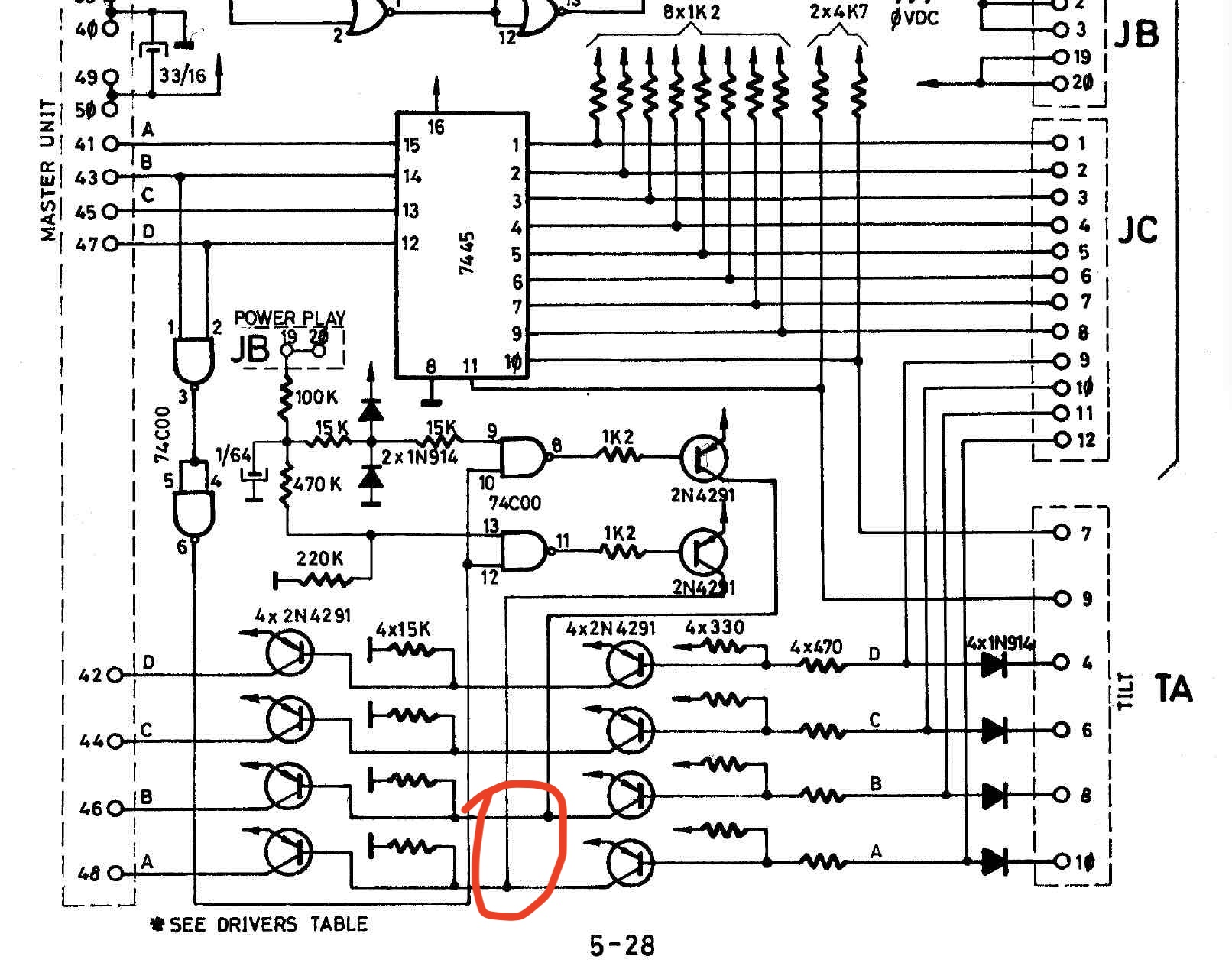
2.4.5. is considered by the system as a major fault, which means that the pinball will halt, when it detects this error. 2.4.5. is caused by a "SHORT IN DRIVER". In general, this comes from a burnt coil, power transistor, or both.
But sometimes, after checking all coils and transistors OK, the error 2.4.5. is still there. In such a case, the problem could come from the short/open test circuitry which resides in the mux board.
This part of the Mux board often fails. That might be the 7400 or the 7445. But it is also worth it checking the 10x2N4291. A dead component here may distort the return values of the switches on AB return lines. Then, an accidental 2.4.5 may result. Always check the 7400 and the 7445, when you get a machine that was previously in an unknown condition. Also check the flat cable on MA and make sure connections are good.
Sometimes, after entering attract mode, the displays are flickering 44444/00000 on all 4 players. The selftest has completed successfully. But the pinball is out of control. Pressing the replay button has no effect. in 90% of cases, this is caused by at least "tilt" and "replay" switches simultaneously seen (by MPU) as closed together. The pinball then thinks it is entering "open coin door" mode and starts to display representation areas. By construction, it starts with area #4. and since replay button appears to never being released, the display alternates showing area number (4) and its content (0). And it cycles forever between these 2 screens, since no switch looks to be released.
This means that the switch matrix control circuitry on the mux board is wrong and that several lines are locked up.
Culprits are generally the same (mainly on returns A&B) as in 2.4.5. forever
I will tell you about a fault I had with a Recel System 3 pinball machine, one I had been carrying around for a long time.
One fine day the machine began to emit a low-frequency vibration coming from the relay on the power-supply board, the relay driven by the "in play" signal.
Apart from the annoyance of the noise, the most troublesome consequence was a loss of power at the flippers. The relay controls the 44 V supply to the coils. By chattering—making and breaking contact at about 50 Hz—the available power to the coils was roughly halved.
The first thing to have done would have been to look at the waveform of the 7.5 V supply after rectification from the transformer. But that is not terribly convenient, and it was so much simpler to blame the relay at first glance. It’s forty years old; it has lived its life. Let’s replace it.
First question: what pull-in voltage for that relay? 6 V or 9 V? Fine, order both and we’ll see…
After replacement (and choosing the 9 V version), the machine resumed normal operation… for about twenty minutes.
A word on relay types. There are essentially two pin patterns: one with pins at right angles, and another with the secondary pins set a little diagonally. Better to take the right-angle pin model, which is the original footprint. Otherwise you can make it work by mounting the relay on a piece of vero board and improvising a solution—but it’s fiddly. It cost me half a day. Not to mention that working on that board is no picnic. Be careful not to finish ruining the solder joints of the already tired wires coming from the transformer. Check them carefully after you’re done. If not, you’ll be rewarded with more faults on other supply rails for sure.
After twenty minutes, the buzzing returned with a vengeance.
Following the adage "replace things at random rather than think," I assumed the relay driver transistor must be at fault — an NPN, SC107 with an unusual pinout. After swapping it for a BC337 and bending the leads to fit an SC107 footprint, guess what happened… No improvement.
At this point you’re thinking he must have hooked up an oscilloscope or something… Of course I did not!
I preferred to make conjectures about the root cause. Since the vibration resembled a 50 Hz frequency, the problem could only be the filter capacitor, naturally!
So I replaced the capacitor, labeled 220K. Which, frankly, tells you little… 220 nF, 220 µF? I didn’t have the right part anyway. A 1 µF electrolytic would do.
No change. Neither better nor worse.
At that stage I finally measured the voltage. Unloaded: 9 V. Under load: 2.88 V.
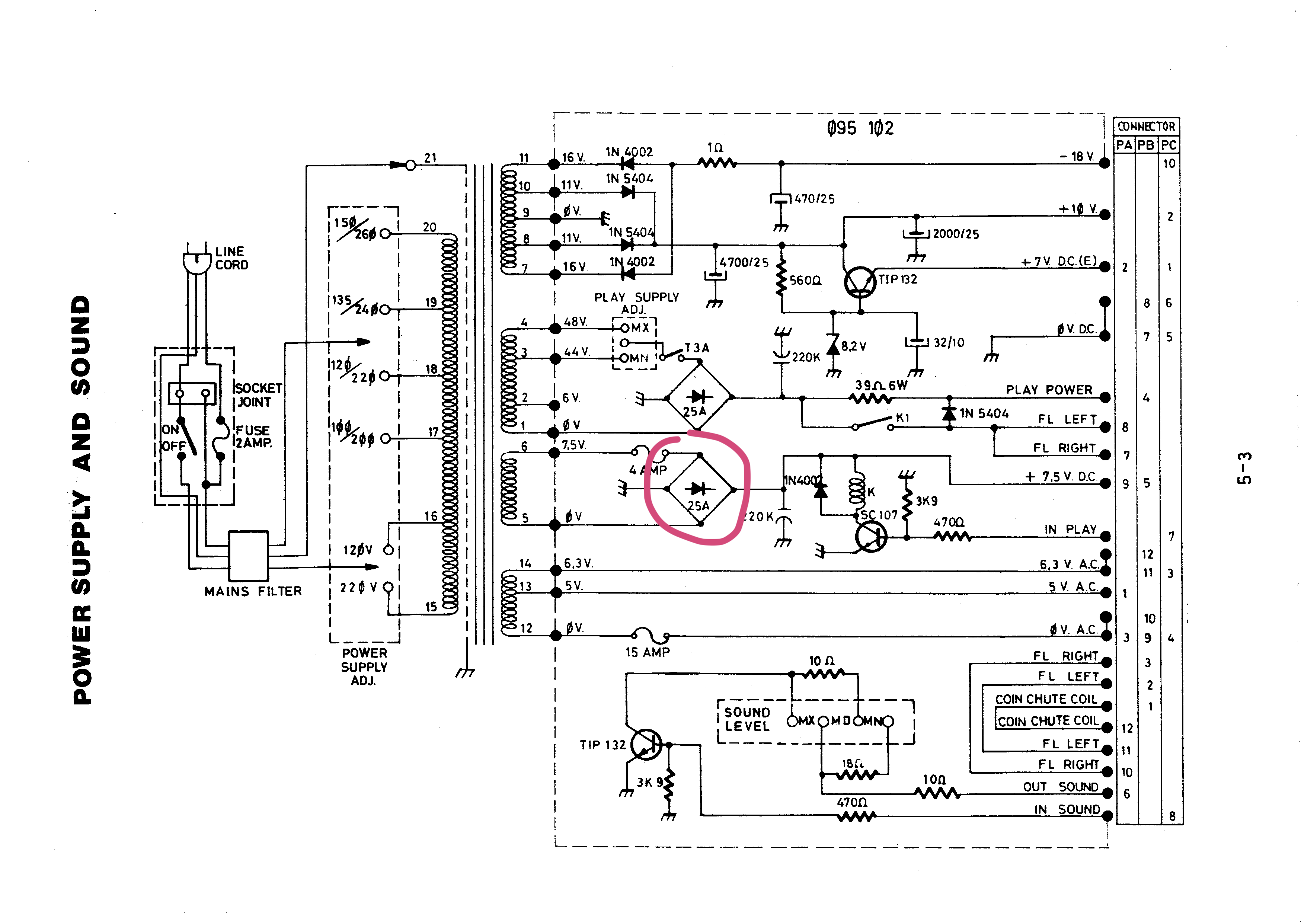
Was it really necessary to measure at that point, given that I had already changed everything except the diode bridge? The bloody blasted DIODE BRIDGE. Marked 25 A.
So, order a 25 A diode bridge. Besides, the general documentation seems unanimous that aging bridge rectifiers, once run hot, show large voltage drops across the diodes under heavy load.
Replacing the diode bridge (not easy—an awful lot of solder to desolder) and, of course, everything worked perfectly. The lamps driven by the MPU (the flashing lamps and the bonus lamps) had never shone so brightly. They are fed by the same 7.5 V source, as is the coin chute coil.
Problem solved, then—after two years.
Conclusion: If you have power-supply troubles, always measure the output voltages both under load and unloaded; if there is a large discrepancy, suspect first the diode bridge, or possibly an old solder joint somewhere on the board acting as a resistor and causing a severe voltage drop as current increases.
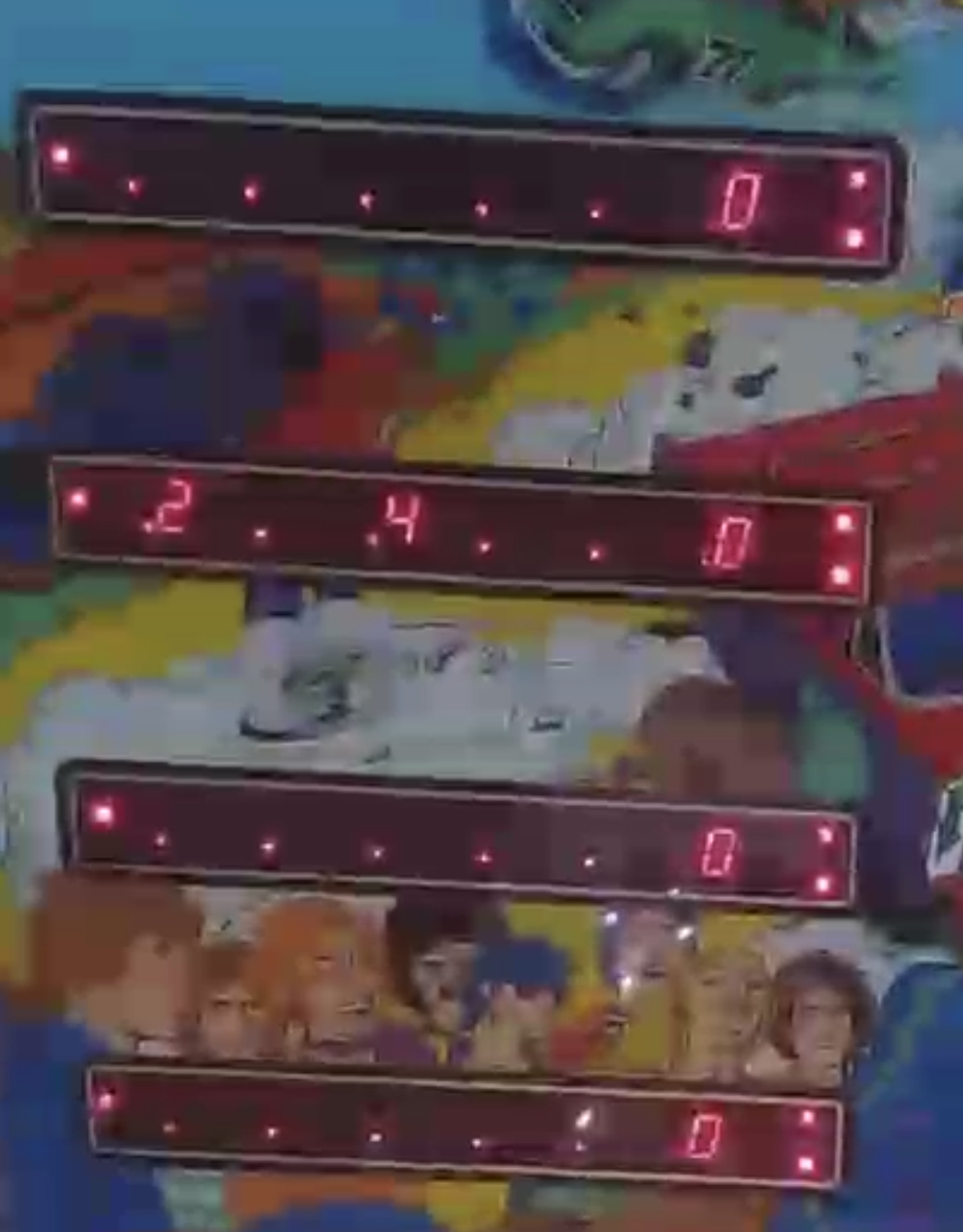
On a Recel System 3, each counter has four LEDs:
To manage this 1-by-1 extension of the DPs, there is the A3 circuit on the Display Board. A3 is an 8-input NAND logic gate (SN7430). After 50 years, this gate is often faulty. It is usually the cause of these strange flashes that are not synchronised with anything.
Another typical symptom is what you can see on the illustration picture above : During the pinball startup sequence, you will observe lighten DPs on all 7-digits of all counter's including those which are off (value F) ; or vice- versa.
Replace this IC, and everything should be back to normal.
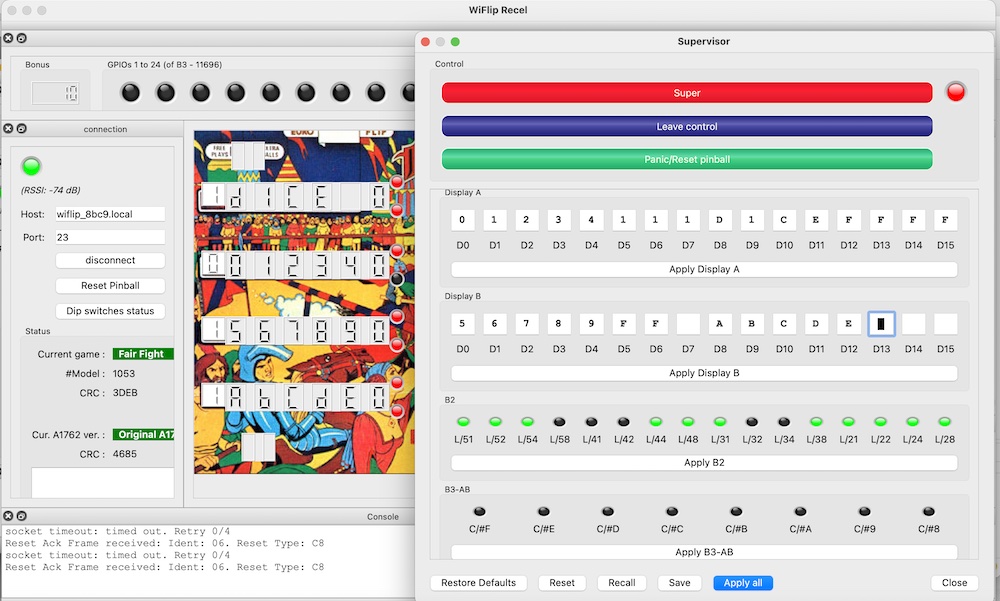
A new video has just been published. It demonstrates all the possibilities of WiFlip's supervision mode applied to RECEL System 3 pinball machines. See it on :
WiFlip Supervisor

RS3CLN is an exact replica of the original Recel system III MPU which is used in several Recel pinballs from the 70’s. Dimensions, connections, timings are totally indistinguishable. To make it work in a Recel pinball, just disconnect the 3 connectors (PC, MA, MB) from the old MPU and unmount it from the metallic backbone (unscrew the plastic spacers and the power transistors). Then, mount the RS3CLN replacement board in the same way, with the spacers, and reconnect the 3 connectors., PC, MA, MB. That’s it.
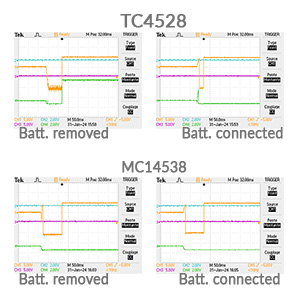
When the CPU of a Gottlieb System 1 doesn't start at all even though the clocks signals are good, it's often worth looking at the PO reset signal (TC1 pin 14) . In fact, the SCL4528BE monostable may be out of order or a surrounding component may be causing the reset duration to be too short.
Under 30ms, a PPS4 won't start properly. However, when you're looking to replace the SCL4528BE, which you can hardly find anymore, you may come across a TC4528, an MC14528B or a CD14528B that are pin-to-pin compatible.
But beware!
In fact, the f(Rx, Cx) timings are very different from one IC to another, and so instead of generating a 300ms reset, it creates a reset of only 30ms.
It turns out that the correct replacement for the SCL4528BE is the CD14538BE and not the CD14528B as might have been expected.
Good news! They are available in DIL 16 from Farnell, for example.

We've created an Android app that lets you connect a pinball machine to your smartphone over WiFi. All you need is a PPS-4 clone.
On the smartphone, you can read the 24 configuration dip switches, keep track of the program running on the pinball machine or watch the scores and other information being displayed in real time.